
Lauderdale County Criminal Court Cases
Lauderdale County criminal court cases are divided by venue. The Eleventh Judicial Circuit court site identifies Circuit Court as the felony-level trial court. District Court handles misdemeanors, preliminary hearings, traffic matters, and other assigned work. Both county courts use the Circuit Clerk at 200 South Court Street in Florence. The clerk is the official keeper of pleadings, notices, docket entries, judgments, sentences, warrants, and financial activity. One clerk office manages ten record divisions, including Criminal, Traffic, Juvenile, and Warrants.
City cases form a separate layer. Florence Municipal Court keeps Florence-police misdemeanor and traffic cases. Killen Municipal Court does the same for Killen matters, and Rogersville Municipal Court holds town ordinance, traffic, and locally prosecuted misdemeanor files. A municipal case may never become a Lauderdale County Circuit file unless it is appealed or transferred. That is why a county-level search can be clear even though a city court still has the matter.
Lauderdale Court Case Types
The case prefix and venue help identify the right Lauderdale County criminal court record. A CC matter is a Circuit Criminal case, usually tied to felony prosecution. A DC matter is a District Criminal case. Traffic records may use a TR classification, while a city citation or ordinance case can remain outside the county clerk's main Circuit docket. The charge at booking does not decide the final court classification. A complaint, information, or grand-jury indictment may amend or replace it.
- Complaint
- A sworn allegation that starts a case or supports a warrant.
- Indictment
- A grand jury's formal felony charge, filed as part of the court case.
- Docket
- The dated list of filings, hearings, orders, and other events in a case.
- Disposition
- The final result for a charge, such as conviction, acquittal, dismissal, or nolle prosequi.
Ask the clerk which division and case type to use when the prefix is not known. This small step can prevent a search of the wrong Lauderdale County court index.
Searching Lauderdale County Case Records
Start with the free setting-date docket when a hearing date is known or likely. Use AlacourtACCESS, also called Just One Look, for a broader name or case-number report. The full service needs an account and payment. The clerk counter and telephone line remain vital for certified copies, old files, non-imaged material, and cases omitted from electronic results.
- Open the free Lauderdale County daily docket search, choose a setting date, and add a last name if useful.
- Use AlacourtACCESS for a broader statewide name or case-number search and open the matching Lauderdale County case detail.
- Check whether the record is CC, DC, TR, or municipal before treating the search as complete.
- Read the docket events, filed charge, disposition for each count, sentence, and any linked appeal.
- Call the Circuit Clerk at 256-760-5728 for the final judgment, certified copy, archive help, or a missing electronic record.
The free form is quite narrow. The official Lauderdale docket source shows how the date and last-name controls work.
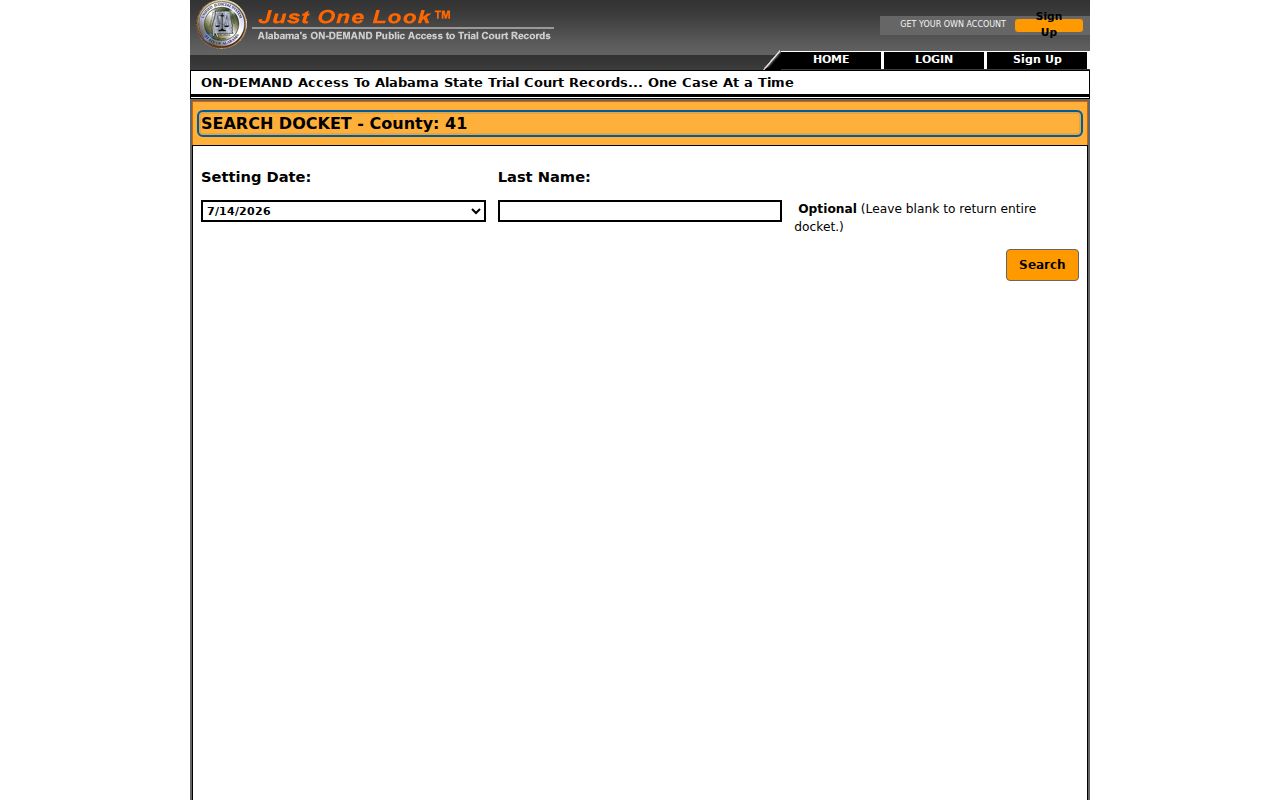
The screen supports a quick calendar check, but its own warning says some Lauderdale County criminal court cases may not appear.
| Field Label | Type | Required | Notes |
|---|---|---|---|
| Setting Date | Dropdown | Yes | Select one of the five dates shown on the current form. |
| Last Name | Text | No | Leave blank to return the whole docket for that setting date. |
| Search | Button | Yes | Generates the docket; missing cases should be checked with the clerk. |
Lauderdale Cases Behind an Account
AlacourtACCESS offers more depth than the free daily docket. It covers Alabama Civil, Domestic, Criminal, and Traffic trial records, with name and case-number searches. The published price is $9.99 for a name search with one case detail or a case-number search with one detail. Each added case detail is $9.99. Images cost $5 for the first 20 pages, then $0.50 for each additional page. Account sign-up asks for contact details, an email address, a password, and agreement to the service terms.
The account report is useful, yet it is not the final word on every Lauderdale County criminal case. Exact availability varies. A sealed file, a protected matter, an older record, or a document not yet imaged may be absent. When a certified outcome matters, obtain the case-action summary and judgment from the Circuit Clerk rather than relying on a web result alone.
The official account portal shows the paid statewide entry point used for Lauderdale County trial records.
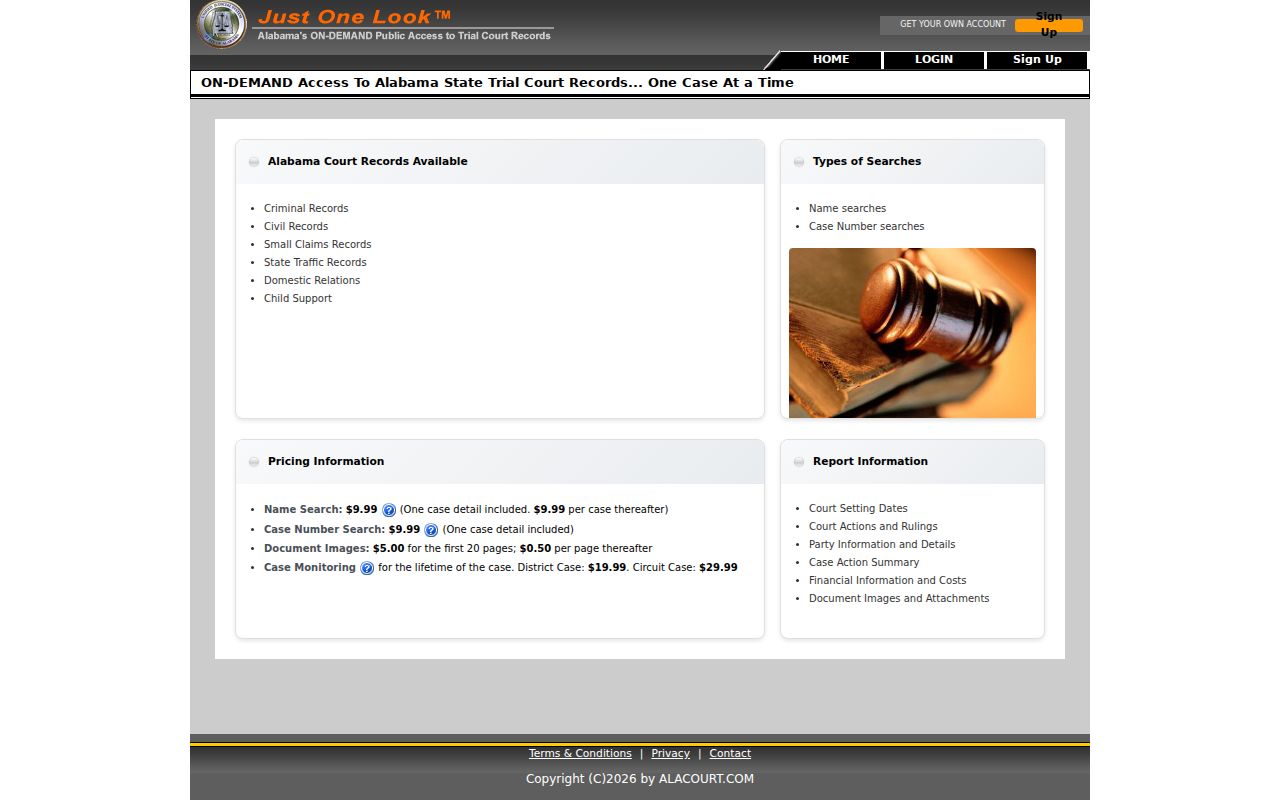
This login separates full case reports from the free, date-based Lauderdale County docket search.
Inside a Lauderdale County Case File
A Lauderdale County criminal court file traces what the court did, count by count. It may include the complaint or indictment, appearances, motions, pleas, orders, and final judgment. The case file can also carry bond details, sentence terms, probation, fines, costs, restitution, and a linked appeal. It does not replace the police narrative. The arresting agency holds that report, while the court file answers what was formally prosecuted and how it ended.
| Case Number & Court | Identifies the venue, case type, and file used by the clerk. |
|---|---|
| Charging Document | Shows the complaint, information, or indictment and the filed allegations. |
| Docket Entries | Lists filings, notices, motions, orders, and other court events by date. |
| Hearing Dates | Records settings for arraignment, motions, trial, sentencing, and review. |
| Disposition & Judgment | States the result for each count, including dismissal, acquittal, or conviction. |
| Sentence & Conditions | Shows confinement, probation, fines, costs, restitution, and other ordered terms. |
Private identifiers and victim information should be redacted. A certified disposition is the best clerk-issued record when the result must be confirmed.
Certified Lauderdale Case Dispositions
For a certified Lauderdale County criminal court disposition, contact the official Circuit Clerk's office at 200 South Court Street, Florence, AL 35630, or call 256-760-5728. The mailing address is P.O. Box 776, Florence, AL 35631. Public hours are Monday through Friday, 8 a.m. to 5 p.m. Give the defendant's name, an estimated filing year, the court level, and the case number if known. Ask for the case-action summary and the final disposition or judgment.
Lauderdale Circuit Clerk
200 South Court Street
Florence, AL 35630
256-760-5728
Monday-Friday, 8 a.m.-5 p.m.
Request the complaint or indictment and sentencing order separately if those documents are also needed. Alabama Rule of Judicial Administration 30 governs clerk copy services, but the current total should be confirmed with the office. No guess should be made about certification or archive fees.
How a Criminal Case Moves
A Lauderdale County criminal case can begin with arrest or summons, followed by an initial appearance and bond decision. A misdemeanor complaint may stay in District or municipal court. A felony can move through a preliminary stage and then to a grand jury. If an indictment is returned, arraignment follows and the defendant enters a plea. Discovery, motions, settings, a negotiated plea, or trial come next. Judgment, sentence, and any appeal complete the public court trail.
Case flow: Charges Filed › Arraignment › Pretrial › Plea or Trial › Disposition › Sentencing
The intake charge may change at several points. Read the indictment and the final judgment together before describing the outcome.
Lauderdale Charges Can Change
A booking charge reflects the accusation recorded at jail intake. It may not match the charge a prosecutor files. A grand jury may return a different felony count, the prosecutor may dismiss a count, or a plea may resolve an amended charge. Each step creates a different record. Lauderdale County criminal court cases are therefore the right place to confirm the prosecuted charge and final result, while the booking sheet remains evidence only that an intake event occurred.
Disposition terms matter. An acquittal is a not-guilty result. A dismissal ends the count without a conviction. Nolle prosequi means the prosecutor declined to continue it, while a conviction is a judgment of guilt. If the state criminal-history record does not show the court's result, use the certified order in the ALEA review and challenge process. The wider Lauderdale County criminal history overview explains how the courthouse and state repository fit together.
Missing Lauderdale Court Records
An empty online result does not prove that no Lauderdale County criminal court case exists. The free docket is built around setting dates. The clerk expressly warns that some cases may not appear. Alacourt access can also omit protected, older, or non-imaged material. Juvenile, Youthful Offender, sealed, and expunged cases are expected gaps. A municipal matter may sit with Florence, Killen, or Rogersville rather than the county clerk.
Call the clerk and ask for the correct division, archive check, and certified case-action summary. For a city charge, call the municipal court that received it. Florence Municipal Court is at 256-760-6625. Killen Municipal Court uses 256-757-1246 and killencourt@att.net. Rogersville directs court inquiries through the official town directory. These venue checks are more reliable than repeating the same name search in one database.
Note: A courthouse record and an ALEA rap sheet serve different purposes, so compare both when reviewing your own history.
Case Record Access & Restrictions
The Alabama Open Records Act, chiefly Alabama Code sections 36-12-40 and 36-12-41, supports inspection and authorized certified copies of public writings. Court access is also governed by judicial privacy and confidentiality rules. Public access does not extend to every part of every Lauderdale County criminal court file.
Juvenile and Youthful Offender matters, sealed or expunged files, victim identities in protected cases, account numbers, Social Security numbers, and some active investigative material may be closed or redacted. Grand-jury deliberations are secret even though a filed indictment can become part of the court case. Online views may contain less than the clerk-held file. When a record is withheld, ask which rule applies and whether a nonconfidential portion can be released.